Photo Gallery: 63rd Drive
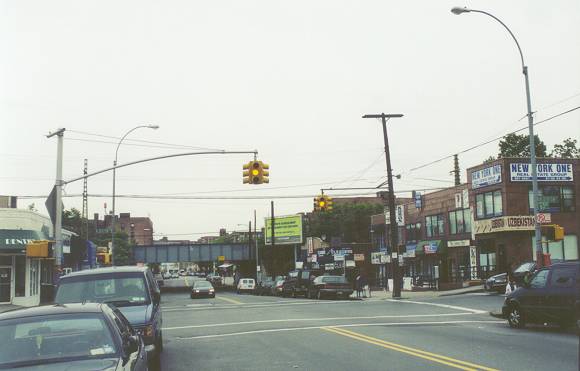
| Taking a break from constant southward views, we look north from Alderton Street, on the other side of the tracks. The building housing New York One Real Estate used to be the site of the Esso station where Harry continued to spring new leaks on cars being serviced and where my father talked on the phone while the library caved in.Those stores went up sometime in the 1980's. The Uzbekistan business below the realty sign doubtless serves many in the area from the former Soviet Republics in Asia. It's hard to fathom today, but only a scant few hundred years ago, Samarkand, Balkh, Merv and Bukhara were centers of the Euro-Asian-North and East African universe and the places where anybody who was anybody went to do business. One might fairly say that before Genghis Kahn and his successors laid them waste in a decades long fit of rage that was really the fault of their Iranian neighbors to their south, these Uzbek cities were to the rest of the world what New York City is today. The hubris with which we so easily forget the fleeting fortunes of all empires and great civilizations is staggering. |
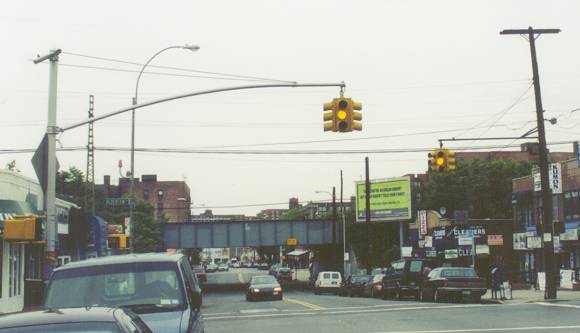
| What the hell; I like cropping photos. The very live power line stanchion astride the railroad tracks is of the same style as numerous rusty ghost stanchions still brooding over the overgrown thickets of the dead tracks, which separate from this main trunk line only a couple of blocks to the right on their ghostly trek towards the Rockaways. As tall as that pole is, many of those along the dead tracks are completely submerged beneath foliage. Again, as in the paragraph above, we are so oblivious to how fast everything we know can be swallowed up just by grass and trees, let alone other nations yet unborn, and it can all be over in the blink of an eye. Looking at the dead tracks, you'd think they were buried for five hundred years. It's only been 39. |
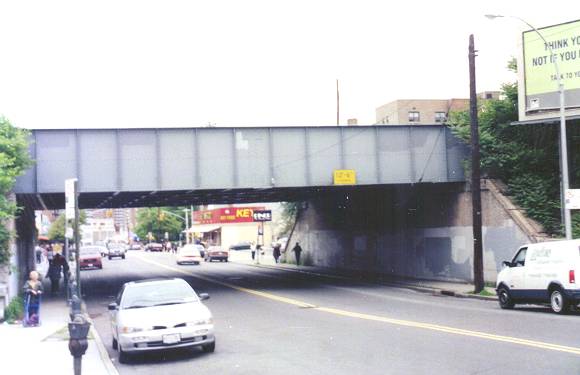
 Peeking under the tracks, there's the fire eating
Key Food and the diner. The old coin operated analog parking
meters like the one in the foreground will increasingly become
history as we move through the Zeroes (what do you call the first
decade of a century anyway?). A station used to sit up there.
It was abandoned in 1962 along with the Rockaway Branch which
it served, despite being on the mainline trackbed. For many years,
we still had easy access to the wide, roomy platform bed, but
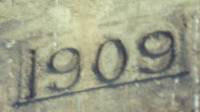
now it is effectively fenced off. These tracks and this overpass
have been around here way before Rego Park existed, as this engraving
from under the tracks notes. The 100th anniversary is only a
few years away as I write this, February 2001. Peeking under the tracks, there's the fire eating
Key Food and the diner. The old coin operated analog parking
meters like the one in the foreground will increasingly become
history as we move through the Zeroes (what do you call the first
decade of a century anyway?). A station used to sit up there.
It was abandoned in 1962 along with the Rockaway Branch which
it served, despite being on the mainline trackbed. For many years,
we still had easy access to the wide, roomy platform bed, but
now it is effectively fenced off. These tracks and this overpass
have been around here way before Rego Park existed, as this engraving
from under the tracks notes. The 100th anniversary is only a
few years away as I write this, February 2001. |